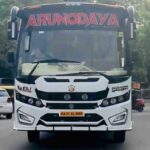
When searching for 30 seater bus rental in Bangalore or 32 seater bus rental in Bangalore, many travelers assume these are completely different vehicles. In reality, the difference is often much smaller than most customers expect.
Whether you are planning a corporate outing, family tour, wedding transportation, school trip, pilgrimage journey, or outstation vacation, understanding the actual difference between a 30-seater and a 32-seater bus can help you make a smarter booking decision.
Many bus rental companies advertise both options, but are they truly different vehicles or simply different seating configurations of the same bus?
Let’s uncover the facts.
When customers compare 30 seater bus hire in Bangalore and 32 seater bus hire in Bangalore, they often imagine:
However, in many cases, these assumptions are not accurate.
The reality is that most 30-seater and 32-seater buses are built on the same platform and differ only in seat arrangement.
One of the biggest misconceptions is that a 32-seater bus is significantly larger than a 30-seater bus.
In reality, many operators use the same vehicle chassis from manufacturers such as:
The vehicle dimensions are usually identical.
The only difference is how the interior seating is arranged.
This means that when booking a 30 seater bus on rent in Bangalore or a 32 seater bus for rent in Bangalore, you may actually be looking at the same vehicle with a slightly different seat layout.
The primary distinction is exactly what the name suggests—two extra seats.
A 30-seater bus accommodates 30 passengers.
A 32-seater bus accommodates 32 passengers.
That may not sound significant, but those two additional seats are often created by modifying spacing inside the cabin.
Instead of increasing vehicle size, operators typically optimize the seating arrangement to fit more passengers.
For many travelers, this is the only noticeable difference.
This is where comfort becomes important.
When two additional seats are added:
For short-distance city travel, most passengers won’t notice a major difference.
Another common myth is that a 32-seater bus provides more luggage capacity.
In most cases, this is incorrect.
Since both buses often share the same body structure:
The extra seats typically do not create additional storage space.
Therefore, luggage capacity should not be the deciding factor when choosing between the two options.
When planning outstation travel, comfort often has a bigger impact than capacity.
Imagine a group of 26 passengers traveling from Bangalore to Kerala.
Would you choose:
The better question is whether your group needs additional seats at all.
Many experienced travelers prioritize:
These factors often contribute more to travel satisfaction than two extra seats.
Professional trip planners frequently recommend a 30 seater bus rental in Bangalore for groups of 25 to 28 passengers.
Why?
Because passengers enjoy:
This makes a 30-seater an excellent choice for:
Corporate Trips
Employees can travel comfortably during long journeys.
Family Tours
Families appreciate additional seating flexibility.
Wedding Transportation
Guests enjoy a relaxed travel experience.
Pilgrimage Tours
Senior citizens benefit from extra space during extended travel.
This is perhaps the most important tip.
Instead of relying solely on descriptions like:
Ask the operator for:
Visual verification helps you understand exactly what you are booking.
Many buses advertised under different seating capacities may look nearly identical.
For corporate transportation, comfort often outweighs maximum capacity.
A 30 seater bus hire in Bangalore is usually ideal when carrying:
Passengers enjoy a more spacious journey, particularly during multi-day business trips.
Family groups generally prefer comfort over maximum occupancy.
For a group of 25–28 travelers, a 30 seater bus rental in Bangalore often provides a better experience.
The additional space allows families to travel comfortably during weekend getaways and holiday tours.
Choose a 30-Seater If:
Choose a 32-Seater If:
So, are 30-seater and 32-seater buses really different?
In many cases, not significantly.
Most operators use the same vehicle platform and simply adjust the seating layout.
The difference is usually:
For many travelers booking a 30 seater bus on rent in Bangalore, comfort often outweighs the benefit of two extra seats.
Before booking, always request real photos, confirm the seating layout, and choose the option that best matches your group size and travel distance.
Remember: the most comfortable journey is not always the one with the highest seating capacity.
Frequently Asked Questions
Is a 30 seater bus the same as a 32 seater bus?
In many cases, yes. Both often use the same chassis and body design, with the difference being only the seating arrangement.
Which is better, a 30 seater or 32 seater bus?
A 30-seater is usually more comfortable for smaller groups, while a 32-seater is ideal when maximum seating capacity is needed.
Does a 32 seater bus have less legroom?
Often yes. Additional seats may slightly reduce passenger space and legroom.
Why do bus operators offer 30 and 32 seater versions of the same bus?
Different seating layouts allow operators to cater to varying group sizes without changing the vehicle itself.
Is the rental cost higher for a 32 seater bus?
Not always. Pricing usually depends on vehicle type, travel distance, trip duration, and amenities rather than just seat count.
Which bus is more comfortable for outstation trips?
For long-distance travel, a 30-seater configuration is often preferred because it generally offers slightly better passenger comfort and space.
+1-222-333-4444